
Deep-dive pages are intentional. Buyers of industrial laser systems deserve engineering data — not adjectives. Below, the architecture, measured performance and validation discipline that define the TRUMPF laser platform.
The TRUMPF TruDisk architecture places the active laser medium as a thin, directly water-cooled disk rather than a long rod. That single geometric decision unlocks three capabilities: sub-M²<1.1 beam quality even at 6–16 kW power classes, <1% RMS long-term power stability, and a wavelength at 1030 nm that couples efficiently into most industrial metals.
The alternative TruFiber platform — an ytterbium-doped active-fiber architecture — serves the 1–8 kW precision-cutting market with single-mode beam quality and fiber-delivered flexibility for robotic integration.
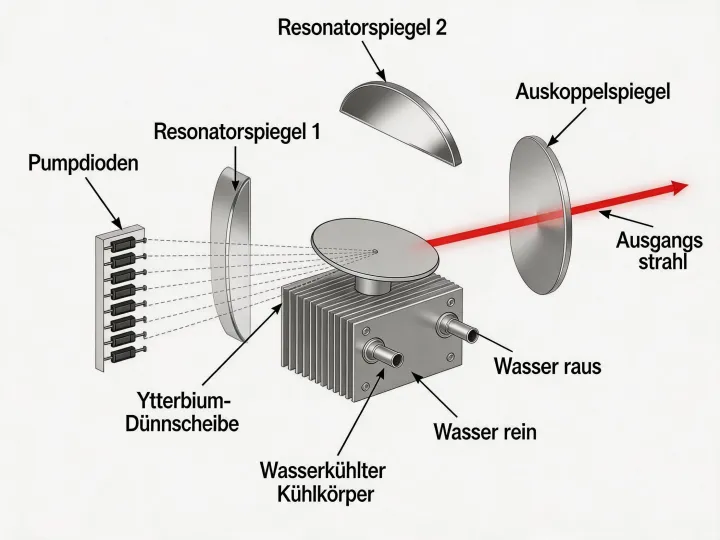
Each parameter below is verified on every unit during factory burn-in and documented on the test report that ships with the machine. These are characteristic values — customer-specific reports list as-tested numerics.
| Parameter | TruDisk | TruFiber | TruPulse nano | Test Method |
|---|---|---|---|---|
| Wavelength | 1030 nm | 1070 nm | 1064 nm | Spectrometer, in-line |
| Power Range | 2 kW – 16 kW | 1 kW – 8 kW | 20 W – 100 W | Calibrated power meter |
| Beam Quality (M²) | < 1.3 (multi-mode) | < 1.1 (single-mode) | < 1.3 | ISO 11146 |
| Power Stability (RMS) | ± 1% | ± 1.5% | ± 2% | Four-hour continuous run |
| Wall-Plug Efficiency | 30 – 35% | 35 – 42% | 10 – 14% | AC input vs optical output |
| Pulse Duration (if pulsed) | n/a (CW) | CW or 2 ms | 2 – 250 ns | Photodetector + oscilloscope |
| Maintenance Interval | Annual PM | Annual PM | Annual PM | Factory PM schedule |
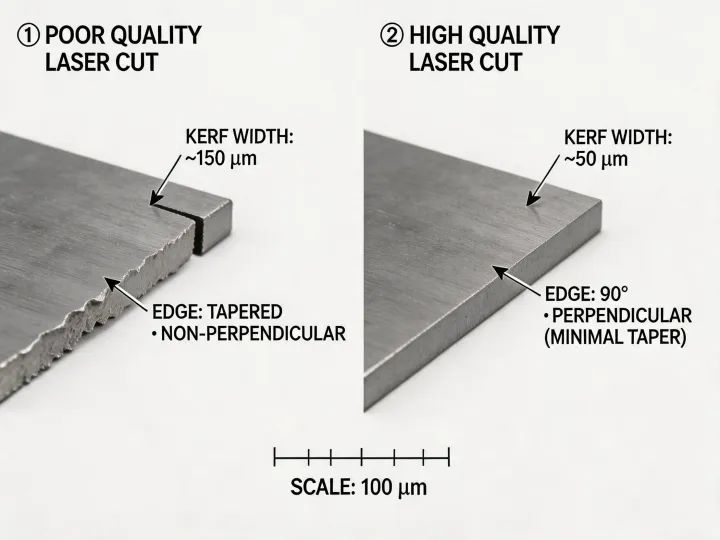
Early fiber lasers struggled on sections above 10 mm — typical issues included striated edges, excessive dross and burr. TRUMPF's BrightLine Fiber is a cutting-head plus process-parameter package that reshapes the beam profile for thick-section work, reaching ISO 9013 Class 1 edges at 25 mm mild steel and Class 2 at 50 mm.
The technology is not a marketing layer — it is a documented cut-quality matrix cross-referenced to assist-gas pressure, feed rate, pierce time and focus offset. Every customer qualification run is filed against the matrix so process parameters travel with the part.
Process parameters, nesting decisions and production telemetry live inside a single software backbone — not stitched together from third-party point tools.
CAD import, sheet-nesting optimization, automatic common-edge cutting, tab-and-micro-joint placement, and direct post-processing to the TRUMPF control. Typical material utilization gains: 8–14%.
Order-to-cash production management layer — quotation, routing, tracking, and shop-floor operator interfaces. Native integration with SAP, NetSuite and Oracle ERP systems.
24/7 streaming of laser source temperatures, mirror currents, axis servo metrics and chiller pressure. Remote-diagnostic escalation cuts on-site visits for critical alerts by roughly 60%.
Real-time part costing based on the actual nesting plan, measured cut time and assist-gas consumption. Quote-to-ship variance typically tightens within one fiscal quarter of deployment.
We'll send the source-level specification, the BrightLine Fiber cut-quality matrix, and a TruConnect data sample from a representative machine — all under standard mutual NDA.